The Four-Dimension Deal Review: A Weekly Practice for Revenue Leaders
Field Notes
A four-dimension deal review is a weekly pipeline review built around buyer readiness instead of rep activity. For every live deal, the team rates four dimensions, problem conviction, evaluation clarity, outcome confidence, and organizational readiness, on a red/yellow/green scale, then acts on the weakest one. A deal moves at the speed of its weakest link, so the practice surfaces stalls early.

By Wilton Blake, B2B Decision Strategist
17 years in B2B. Now diagnosing why qualified pipeline loses to no decision.
Key Takeaways
Standard pipeline reviews measure rep effort (next step, close date, stage), not buyer readiness. That blind spot is why green-board deals die in "no decision."
Indecision is not one thing. It has distinct forms with distinct causes, so a review that logs every stuck deal as "following up" cannot prescribe the right fix.
Re-run the weekly review around four diagnostic questions, one per dimension: problem conviction, evaluation clarity, outcome confidence, organizational readiness.
Rate every live deal red/yellow/green on each dimension, then act on the weakest link only. The deal moves at the speed of its lowest dimension.
The next action is never "follow up." It is the specific protocol that resolves the weakest dimension.
Track whether the weakest link got stronger week over week, not whether the deal changed stages. Stage movement can mask a deal that is only aging.
Your pipeline review is lying to you. Not on purpose. It is just answering the wrong question every Monday, with a straight face.
Picture the meeting. The board is mostly green. One by one, your reps walk the deals. "Great call last week." "Next steps are set." "They gave me a verbal yes." Close dates hold. Stages advance. Everyone leaves the room a little more confident than they walked in.
Then the quarter closes, and a third of those green deals are gone. Not lost to a competitor. Not killed by a budget freeze. Just gone. They show up in your CRM as "no decision" and in your forecast as a number nobody can account for.
The review did not lie to you. It answered exactly what you asked. You asked about your reps. What did you do, what is the next step, when does it close. Those are activity questions. They measure effort. And effort is not what kills these deals.
What kills them is the buyer's readiness to act. That is a different thing, and your review never measured it.
The review measures effort. Deals die from readiness.
Walk through the questions a standard pipeline review asks. Who is the champion. What is the next step. When will it close. What is the deal worth. Did MEDDIC get filled out. Every one of those is about your side of the table. Your rep, your process, your motion.
None of them ask whether the buyer can actually decide.
That gap matters more than most leaders think, because the most common way to lose a B2B deal now is for the buyer to do nothing at all. The research is blunt about it. Of the deals that stall out in inaction, 56% are lost to the buyer's own indecision rather than a preference for the status quo (Dixon & McKenna, HBR, 2022). The buyer is not choosing to keep things as they are. They are stuck between wanting to move and being unable to.
Here is the part that breaks most review meetings. Indecision is not one thing. It comes in distinct forms with distinct causes. The cleanest map of this comes from psychology, where decision avoidance breaks into four behaviors: choice deferral, status quo bias, omission bias, and inaction inertia, each driven by something different (Anderson, Psychological Bulletin, 2003).
A review that records every stuck deal as "following up" cannot tell those forms apart. So it cannot prescribe the right move. It just schedules another call and hopes the buyer warms up. Hope is not a protocol.
The fix is not a better CRM field. It is a better set of questions. Four of them, one per dimension of buyer readiness, asked about every live deal, every week.
Four questions, one per dimension
Buyer readiness is not a feeling. It scores across four dimensions that predict whether a deal closes or stalls: problem conviction, evaluation clarity, outcome confidence, and organizational readiness. You can read the full model on the buyer-readiness framework page. For the weekly review, each dimension becomes one sharp question and one tell to listen for.
Problem conviction: can they name the cost of standing still?
The question: can the buyer describe, in their own words and numbers, what staying the same costs them?
The tell that this dimension is weak is a buyer who is delighted by your product and silent on their problem. They say "this is really cool." They cannot say what this quarter of not solving it actually costs. Enthusiasm for you is not conviction about the problem. The two feel similar in a demo and behave nothing alike in a forecast.
What strengthens this dimension is not more pressure. It is the right kind of regret. When you make the cost of doing nothing vivid, choice deferral drops. When you make the risk of choosing wrong vivid, deferral rises (Mourali, Yang, Pons & Hassay, IJRM, 2018). So the move is to surface the cost of the status quo, not the danger of the purchase.
Two cautions keep this honest. First, buyers regret switching more than staying, which is why the incumbent always feels safe. That only flips when the switch is justified, so the buyer needs a defensible reason to move, not a louder pitch (Inman & Zeelenberg, JCR, 2002). Second, do not reach for fear. Framing everything around loss is not the reliable lever it is sold as. Across 53 studies, the edge of loss framing over gain framing is small and situational (O'Keefe & Jensen, Journal of Communication, 2009). Conviction is built on a clear cost, not a scary one.
Evaluation clarity: do they know what they are comparing you against?
The question: can the buyer tell you what they are evaluating you against and what criteria would make them say yes?
The tell is the buyer who calls your demo "really helpful" and cannot name a single alternative or a single decision criterion. They are interested. They have no frame for choosing. A buyer without a frame does not pick you. They postpone.
This is where most sellers leave the most on the table, because how a buyer evaluates decides what they end up valuing. Line options up side by side and the easy-to-compare attribute, usually price, dominates. Have a buyer judge options one at a time and the hard-to-measure things, fit and trust and outcome, gain weight (Nowlis & Simonson, JMR, 1997). The seller who helps shape the comparison shapes the criteria. The seller who waits gets compared on a spreadsheet they did not build.
Outcome confidence: do they believe it works in their world?
The question: does the buyer believe your solution delivers the specific outcome they need, in their environment, not in general?
The tell flips from the last two. Here the buyer is not vague. They are hyper-specific. Every conversation circles integrations, onboarding timelines, the one edge case unique to their stack. That is not friction for its own sake. It is doubt wearing the costume of diligence. They want to believe it works for them and they do not yet.
You do not close this gap with another feature tour. You close it with proof shaped to their context: implementation evidence, reference architecture, a clear picture of what the first ninety days look like for a team that looks like theirs. The doubt is specific, so the proof has to be specific too.
Organizational readiness: can the champion actually land this?
The question: can your champion get this through their organization, and do you know the four or five people who actually decide?
The tell is the line every seller has heard. "I need to run this by my team." Then two weeks of silence. The champion was real. The internal selling was not equipped, and the deal died inside a building you never got to see.
The instinct is to arm the champion to persuade each stakeholder one at a time. The research points the other way. Groups make durable decisions when their members share a structured understanding of the problem and of each other's roles. The job is to build one shared frame across the buying committee, not to win a series of private arguments (DeChurch & Mesmer-Magnus, meta-analysis, 2010). And you do not need all thirteen names. You need the four or five who are decisive. Map those, equip those, and the silence after "I need to run this by my team" gets a lot shorter.
The weakest link is the next action
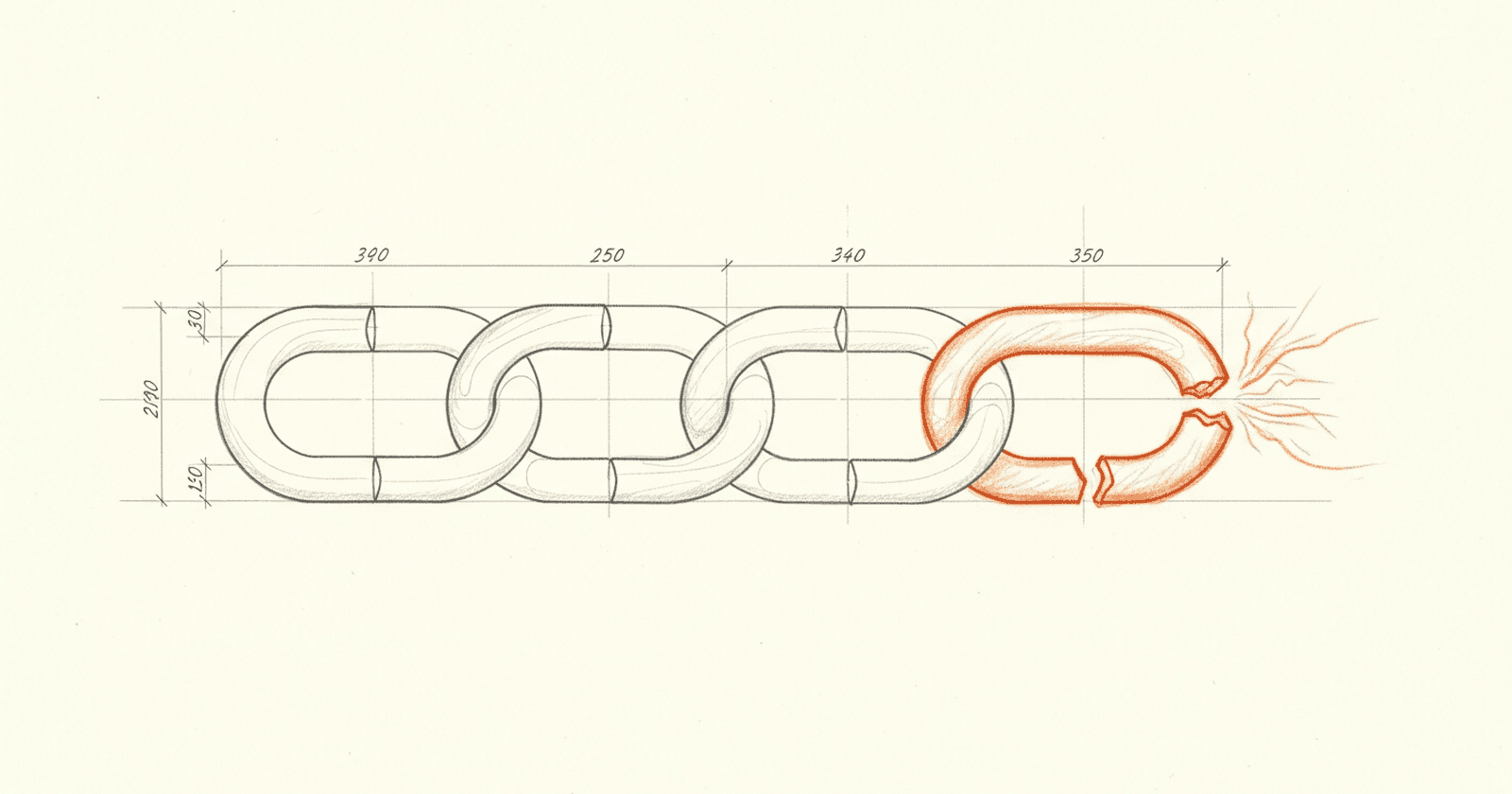
These four dimensions are not a checklist where three out of four is a passing grade. They are a chain. The deal moves at the speed of the weakest link.
A deal can have roaring problem conviction, crisp evaluation clarity, and total outcome confidence, and still die because the champion could not get it through procurement. Three maxed dimensions and one broken one is not a strong deal with a small problem. It is a dead deal with three good excuses.
This is what turns the four questions into a practice instead of a worksheet. For every live deal, you are not scoring four numbers to average them. You are hunting for the lowest one. That weakest dimension is the only thing standing between the deal and a decision, which means it is the next action.
And the next action is not "follow up." It is the specific move that resolves that specific gap.
Weak on problem conviction? The next action builds the case for change before the next real conversation, so the buyer arrives knowing what standing still costs. Weak on evaluation clarity? You hand them a decision framework they trust before they build their own bad one. Weak on outcome confidence? You bring proof matched to their environment before the deal reaches evaluation. Weak on organizational readiness? You map the decisive stakeholders and equip the champion to build one shared frame, before the deal stalls in committee.
"Follow up next week" treats every stuck deal the same. The weakest-link read treats each one as the particular kind of stuck it actually is. That is the difference between activity and diagnosis.
How to run it
The practice fits inside the meeting you already hold. You are not adding a ceremony. You are changing the questions.
First, before the meeting, every rep rates each live deal across the four dimensions. Keep the scale dumb on purpose: red, yellow, green. Red means no evidence the dimension is met. Green means the buyer has shown you, in their words or their behavior, that it is. Yellow is everything in between. The scale being simple is the point. You want a fast read the whole team uses the same way, not a forty-field scorecard nobody fills out twice.
Second, in the meeting, for each deal you look at the weakest dimension only. Not the average. The floor. The rep names it and names the move that resolves it. The deal's official next step becomes that move. If a rep cannot name evidence for a green, it is not green. Conviction you cannot point to is hope with better lighting.
Third, you track movement week over week, but you track the right thing. The question is never "did the deal advance a stage." It is "did the weakest link get stronger." A deal can move from discovery to evaluation in your CRM while its weakest dimension sits red the entire time. That deal is aging, not progressing. Naming the weakest link every week is what tells the two apart before the quarter does it for you.
Underneath all of it is a shift in what the seller's job is. The modern frame for B2B selling is not driving the interaction or closing the sale. It is orchestrating the touchpoints so the buyer becomes more competent at their own decision (Kalwey, Krafft, Lim & Mantrala, Journal of Marketing, 2025). The four-dimension review operationalizes exactly that. Every move it prescribes makes the buyer better at deciding, instead of making your rep better at chasing.
If you want a faster version for a single stuck deal between reviews, I wrote up how to diagnose a stalled B2B deal in four minutes. The weekly review is that same diagnosis, run across the whole board at once.
What changes after a quarter of this
The first thing you notice is fewer surprises. The deals that used to evaporate into "no decision" announce themselves earlier, because a dimension that stays red for three weeks is a flashing light, not a quiet slip. You can act on a flashing light.
The second thing is a forecast you can defend. "Commit" stops meaning "the rep feels good" and starts meaning "all four dimensions are green with evidence." That is a number you can put in front of a board.
The third thing is the one that compounds. Your reps stop asking "what is my next step" and start asking "what is this buyer's weakest dimension." They learn to diagnose. A team that diagnoses does not need you in every deal, which is the only version of scale that holds up. For more on why these deals end in silence in the first place, see why B2B deals end in no decision.
You do not have a sales problem. You have a diagnosis problem. The weekly review is where you fix it, one weakest link at a time.
See where your stalled deals actually stand
If your forecast keeps losing deals to "no decision," the four-dimension review is how you catch them while you can still act. Start by scoring one deal.
Take the free Buyer Readiness Check. Four minutes, no commitment, a diagnostic snapshot of where a deal actually stands across the four dimensions.
Or if you want to pressure-test the practice against your own pipeline, schedule a free scoping call and we will run it on a real deal together.
FAQ
What is a four-dimension deal review?
It is a weekly pipeline review restructured around buyer readiness instead of rep activity. For every live deal, the team rates four dimensions, problem conviction, evaluation clarity, outcome confidence, and organizational readiness, then sets the deal's next action based on its weakest dimension. It replaces "what is your next step" with "what is this buyer's weakest link."
How is this different from MEDDIC or BANT?
MEDDIC, BANT, Challenger, and SPIN are sales methodologies. They qualify the deal and structure the rep's motion. The four-dimension review is a diagnostic layer beneath qualification. It measures whether the buyer can actually decide, which is what those methodologies assume but do not test. It is not a replacement for your methodology. It is what makes your methodology work on deals that would otherwise stall.
How long does the review take?
About as long as your current pipeline review, because it replaces the questions rather than adding a meeting. The reps do the rating before the meeting. In the meeting you discuss only the weakest dimension per deal and the move that resolves it, which is usually faster than the open-ended "walk me through this deal" it replaces.
Why focus on the weakest dimension instead of the overall score?
Because the dimensions form a chain, and the deal moves at the speed of the weakest link. A deal strong on three dimensions and weak on one is not 75% healthy. It is blocked by the one weak dimension, and averaging hides that. Hunting for the floor points you at the only thing standing between the deal and a decision.
Can a small sales team run this?
Yes. The practice scales down better than most, because the only infrastructure it needs is a shared red/yellow/green read and the discipline to act on the weakest link. A two-rep team can run it in a thirty-minute Monday. The framework matters more than the headcount.
Blog